
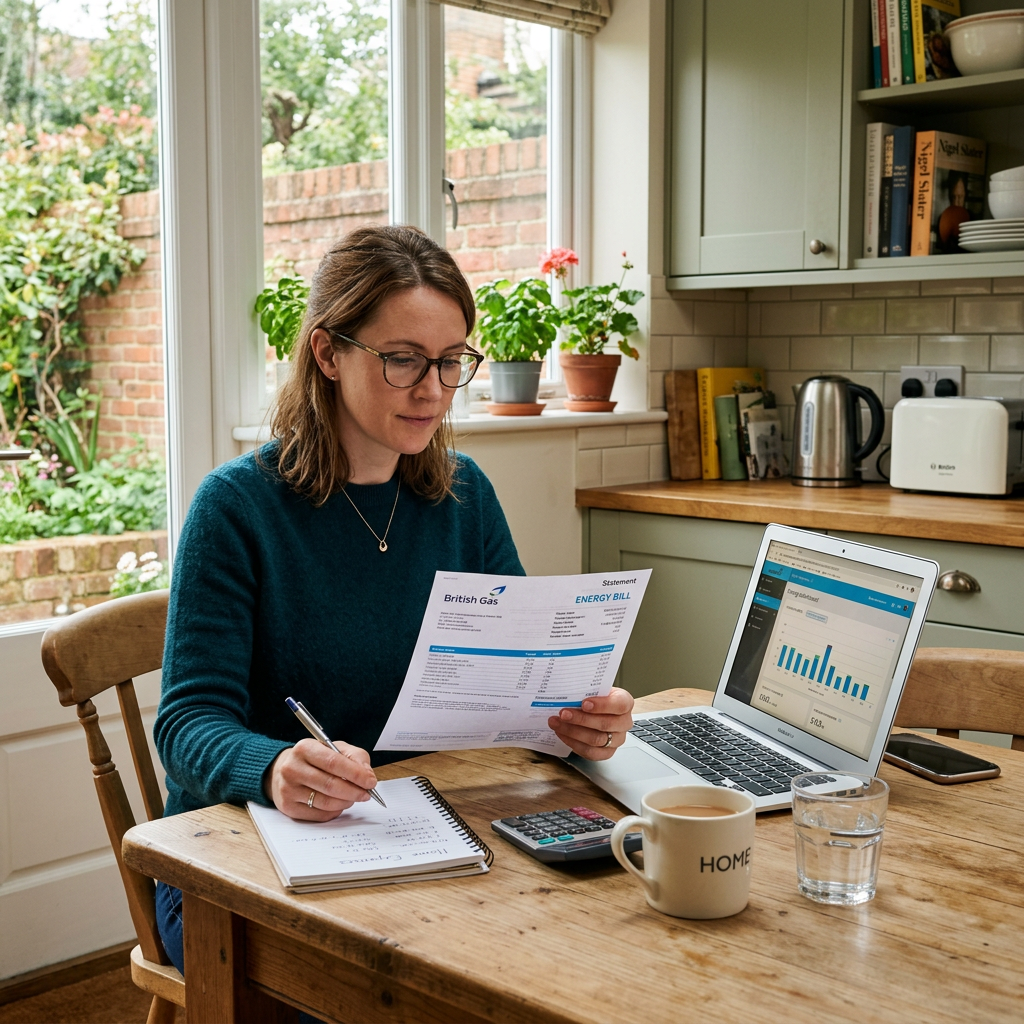
Why Your Energy Bill Can Be Confusing
Most people glance at the total on their energy bill and file it away without reading further. But understanding what makes up that total can reveal whether you’re on the right tariff, spot billing errors, and give you the information you need to compare deals effectively.
UK energy bills follow a broadly standardised format, though the exact layout varies between suppliers. Here’s what every section means. If you want to stay up to date with energy prices, it only takes a few minutes.
Your Account Summary
The first page of most bills gives you a headline summary — the amount due or the credit/debit balance on your account. If you pay by direct debit, you may be in credit (you’ve overpaid) or in debt (you’ve underpaid relative to what you’ve used). A small credit balance is fine; a large one suggests your direct debit is set too high and your supplier is effectively holding your money.
Meter Readings
This section shows the meter readings used to calculate your bill — either readings you submitted, readings taken by a meter reader, or estimates. Estimated readings are shown with an ‘E’. If your bill is based on estimates rather than actual readings, your billed amount may not reflect what you’ve actually used. You can also UK energy market analysis to see what’s available.
Always check that the opening and closing readings on your bill make sense. If you submitted a reading, confirm it matches what’s shown. If estimated readings are consistently inaccurate, submitting regular actual readings will resolve the problem — or ask your supplier to install a smart meter.
Your Unit Rate
The unit rate is the price you pay per kilowatt-hour (kWh) of energy used. It’s shown in pence per kWh (p/kWh) and is the most important figure for comparing tariffs. The same amount of energy usage will cost significantly more or less depending on this single number.
Unit rates vary widely between tariffs and suppliers. A competitive fixed tariff might offer electricity at 22–25p/kWh, while a default variable tariff (the rate you fall onto if you don’t actively choose a deal) is typically higher. Knowing your unit rate is the first step to understanding whether you’re paying a fair price.
Standing Charge
The standing charge is a fixed daily amount — shown in pence per day — that you pay regardless of how much energy you use. It covers the cost of maintaining the connection to your property, metering, and a portion of network costs.
Standing charges typically range from 50p to 70p per day for electricity and 28p to 32p per day for gas — though these vary by region and tariff. Over a year, a standing charge of 60p/day adds £219 to your electricity bill before you’ve used a single unit.
Some tariffs advertise a zero standing charge but compensate with a higher unit rate. Whether this works in your favour depends on your usage level — low users may benefit from no standing charge tariffs.
VAT
Energy bills include VAT at a reduced rate of 5% — lower than the standard 20% rate that applies to most goods and services. This should be clearly shown as a separate line on your bill. VAT applies to both the unit rate charges and the standing charge.
Direct Debit and Payment Details
If you pay by direct debit, your bill will show your current monthly payment amount and whether your account is in credit or debit. Suppliers review direct debits periodically and adjust them based on your actual usage.
If you’re consistently building up a large credit balance — more than one or two months’ worth of bills — you can ask your supplier to reduce your direct debit or refund the excess credit. This is your money, not theirs.
Your Annual Consumption
Somewhere on your bill — often on the back or in a summary section — you should find your estimated annual consumption in kWh. This is the key figure for comparing energy deals accurately. Without it, price comparisons are essentially meaningless.
The UK average is around 3,500 kWh per year for electricity and 11,500 kWh for gas, but your actual figure could be very different depending on your home size, insulation, and usage habits.
Is Your Bill Correct? Key Checks
- Are readings actual or estimated? If estimated, do they seem reasonable?
- Does the unit rate match what you signed up for?
- Is VAT shown at 5%?
- If in credit, is the balance proportionate to your usage?
Use Your Bill to Find a Better Deal
Armed with your unit rate, standing charge, and annual consumption, you have everything you need to compare tariffs accurately. If your unit rate looks high compared to current market deals, it’s worth switching — the process takes around five minutes and can save hundreds of pounds a year.